 Login / Register


 United States ($) USD
 Austria (€) EUR
 Belgium (€) EUR
 Denmark (DKK) DKK
 France (€) EUR
 Germany (€) EUR
 Ireland (€) EUR
 Japan (¥) JPY
 Luxembourg (€) EUR
 Netherlands (€) EUR
 Norway (NOK) NOK
 Sweden (SEK) SEK
 Switzerland (CHF) CHF
 United Kingdom (£) GBP

Erythropoiesis describes the process by which hematopoietic stem cells commit to the red blood cell lineage. The creation of these red blood cells (and their replenishment) ensures efficient oxygen delivery. Megakaryopoiesis involves the development of megakaryocytes from hematopoietic stem cells. Megakaryocytes can in turn generate platelets, which are instrumental in clotting.
Explore our interactive graphics below by clicking on each cell type to bring up a list of markers expressed at that stage of development.
Select a species to begin:
|
|
|

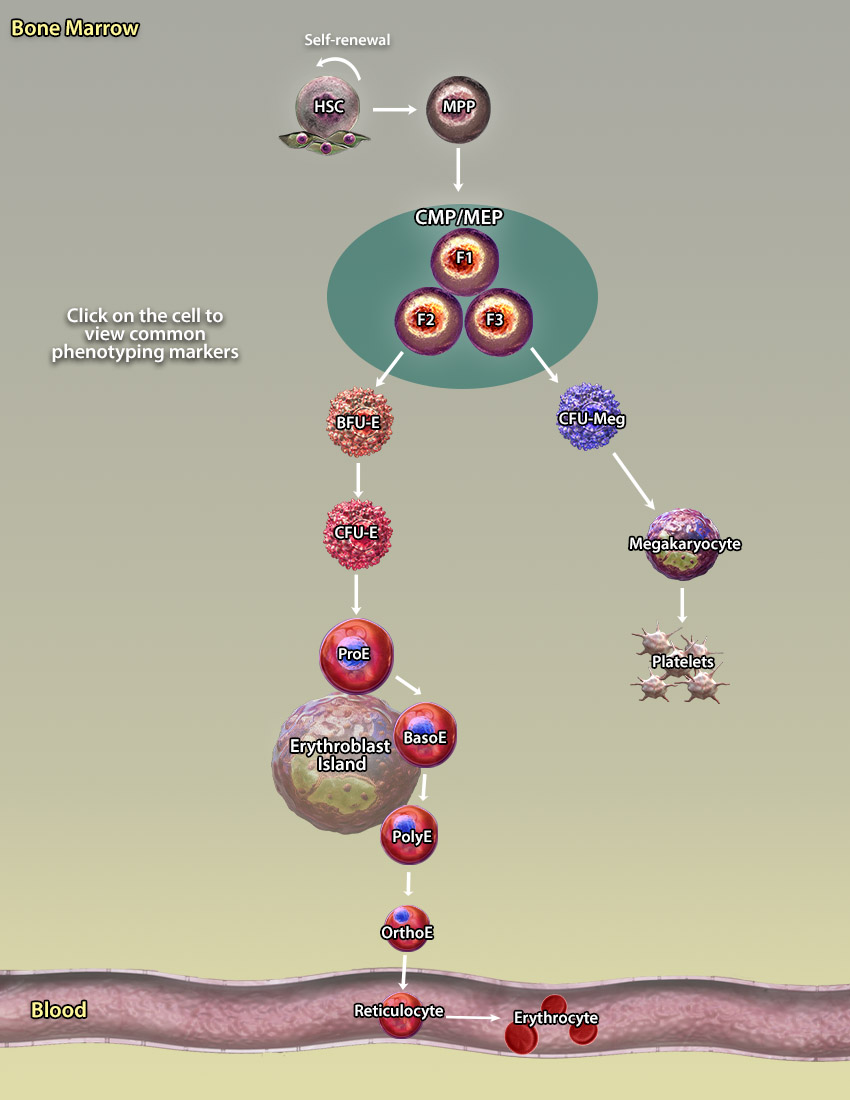
 HSCs are pluripotent cells which gives rise to all blood cell populations of lymphoid, myeloid, and erythroid lineages. HSCs persist throughout the life-span. They have the potential to self-renew to sustain the stem cell pool or differentiate into other multi-, oligo-, and unipotent progenitors which give rise to terminally differentiated cells (1-3, 5, 6).
 MPPs are multipotent progenitors derived from ST-HSCs. They can give rise to another multipotent progenitor, LMPPs, or oligopotent and unipotent progenitors which give rise to terminally differentiated cells (1-3, 5, 6).
 CMPs/MEPs are oligopotent progenitors derived from MPPs. This progenitor can differentiate into erythroid and myeloid lineages (1-3, 5, 6). Recent studies by Notta F et al., have shown that CMPs contain three distinct cellular fractions: F1 (CD71-CD110-), F2 (CD71+CD110-), F3 (CD71+CD110+) (35).
 BFU-Es are the first committed erythrocyte progenitors which can be identified within the MEP subpopulation (31,37).
 CFU-Es are erythrocyte progenitors downstream of BFU-Es. They can be identified within the MEP subpopulation (31,37).
 CFU-Megs are megakaryocyte progenitors identified within the MEP subpopulation (31).
 ProEs are the first erythroid progenitor population of cell that begin to express GPA (34, 36, 37). ProEs are large, committed progenitors which comprise the first stage of erythroblast maturation.
 In the adult, erythroid progenitor cells can be identified in the bone marrow in erythroblastic islands consisting of a macrophage surrounded by erythroblasts. The GPA+ erythroid compartment consists of morphologically distinct, nucleated precursors that progress from ProE to BasoE to PolyE to OrthoE. As these cells mature, they undergo morphological differences including a decrease in cell size and nuclear condensation and polarization. These distinct subsets can be distinguished by expression of Band3 and α4-integrin (32).
 Reticulocytes are immature erythrocytes that have undergone enucleation and have been released into the circulatory system. Unlike mature erythrocytes, reticulocytes retain some organelles, including mitochondria. Before maturing into an erythrocyte, reticulocytes undergo extensive membrane remodeling and cytoskeletal rearrangements. Because reticulocytes retain RNA content, fluorescent dyes that bind to RNA can be used to enumerate reticulocytes in the peripheral blood.
 Erythrocytes are enucleated red blood cells which function primarily to transport oxygen and carbon dioxide. Erythrocytes are very short lived cells and are replenished from the reticulocyte pool every 24 hours (31, 32).
 Megakaryocytes are large bone marrow cell which are responsible for the production of platelets involved in thrombosis and hemostasis (31, 35).
 Platelets, derived from megakaryocytes, have an essential role in thrombosis and hemostasis. Platelets express CD41 and CD61 glycoproteins which form a gpIIb/IIIa (CD41/CD61) complex, also known as integrin αIIbβ3. This complex acts as the receptor for fibrinogen and fibronectin.
 Pre MegE is a megakaryocyte/erythrocyte progenitor identified within the MEP population (13).


Follow Us