APC Annexin V

Pricing & Availability
Regulatory Status
RUO
Other Names
Annexin A5, Dead, Apoptosis
Ave. Rating
Submit a Review
Product Citations
publications
APC_Annexin-V_kit_052318_non-apop
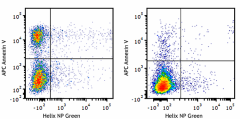
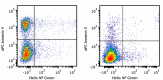
Human T leukemia cell line Jurkat, treated (left) or non-treated (right) with BioLegend’s anti-human CD95 (EOS9.1) mAb (Cat. No. 305704) for 4 hours, then stained with Annexin V- APC and Helix NP Green (Cat. No. 425303 at 5 nM) in Annexin V Binding buffer for 15 minutes at 25°C.
  • APC_Annexin-V_kit_052318_non-apop
    Human T leukemia cell line Jurkat, treated (left) or non-treated (right) with BioLegend’s anti-human CD95 (EOS9.1) mAb (Cat. No. 305704) for 4 hours, then stained with Annexin V- APC and Helix NP Green (Cat. No. 425303 at 5 nM) in Annexin V Binding buffer for 15 minutes at 25°C.
See APC spectral data
Cat # Size Price Quantity Check Availability Save
640919 25 tests 82€
Check Availability


Need larger quantities of this item?
Request Bulk Quote
640920 100 tests 176€
Check Availability


Need larger quantities of this item?
Request Bulk Quote
640941 300 tests 356€
Check Availability


Need larger quantities of this item?
Request Bulk Quote
Description

Annexin V (or Annexin A5) is a member of the annexin family of intracellular proteins that binds to phosphatidylserine (PS) in a calcium-dependent manner. PS is normally only found on the intracellular leaflet of the plasma membrane in healthy cells, but during early apoptosis, membrane asymmetry is lost and PS translocates to the external leaflet. Fluorochrome-labeled Annexin V can then be used to specifically target and identify apoptotic cells. Annexin V Binding Buffer (Cat. No. 422201) is recommended for use with Annexin V staining. Annexin V binding alone cannot differentiate between apoptotic cells and necrotic. Therefore, we recommend using our Helix NP™ Blue (Cat No. 425305), Helix NP™ Green (Cat No. 425303) or Helix NP™ NIR (Cat. No. 425301). Early apoptotic cells will exclude 7-AAD and PI, while late stage apoptotic cells and necrotic cells will stain positively, due to the passage of these dyes into the nucleus where they bind to DNA.

Product Details
Technical Data Sheet (pdf)

Product Details

Verified Reactivity
Human, Mouse, Rat
Reported Reactivity
Other Species
Formulation
Phosphate-buffered solution, pH 7.2, containing 0.09% sodium azide and BSA (origin USA)
Preparation
The purified protein was conjugated with APC under optimal conditions.
Concentration
Lot-specific (to obtain lot-specific concentration and expiration, please enter the lot number in our Certificate of Analysis online tool.)
Storage & Handling
The Annexin V solution should be stored undiluted between 2°C and 8°C, and protected from prolonged exposure to light. Do not freeze.
Application

FC - Quality tested

Recommended Usage

Each lot of this product is quality control tested by immunofluorescent staining with flow cytometric analysis. For flow cytometric staining, the suggested use of this reagent is 5 µl per 100,000 - million cells in a 100 µl volume of Annexin V Binding Buffer (Cat No. 422201). It is recommended that the reagent be titrated for optimal performance for each application.

Excitation Laser
Red Laser (633 nm)
Application Notes

Annexin V Staining

  1. Wash cells twice with cold BioLegend Cell Staining Buffer (Cat. No. 420201) and then resuspend cells in Annexin V Binding Buffer (Cat. No. 422201) at a concentration of 1x10⁶ cells/mL.
  2. Transfer 100 µL of cell suspension in 5 mL test tube.
  3. Add 5 µL of fluorochrome conjugated Annexin V.
  4. Stain with a viability dye, such as PI (Cat. No. 421301), 7-AAD (Cat. Nos. 420403 & 420404), or Helix NP dyes (Cat. Nos. 425301, 425303, & 425305), if desired.
  5. Gently vortex the cells and incubate for 15 min at RT (25°C) in the dark.
  6. Add 400* µL of Annexin V Binding Buffer (Cat. No. 422201) to each tube. *For more concentrated samples, add a minimum of 200 µl of Annexin V Binding Buffer in this step.
  7. Analyze by flow cytometry.

For a better experience detecting apoptosis, we now recommend Apotracker™. Cell staining with Apotracker™ is Calcium independent. Thus, no special buffers are required, and the protocol can be shortened for single-step co-staining with other reagents.

Application References

(PubMed link indicates BioLegend citation)
  1. Koopman G, et al. 1994. Blood 84:1415.
  2. Vermes I, et al. 1995. J. Immunol. Methods 184:39.
  3. Dachary-Prigent J, et al. 1993. Blood 81:2554.
  4. Sekine C, et al. 2009. Int Immunol. PubMed
  5. Grujic M, et al. 2010. J. Immunol. 185:1730. PubMed
  6. Hussain MS, et al. 2013. Hum Mol Genet. 22:5199. PubMed
  7. Feng Q, et al. 2014. PLoS One. 9:95927. PubMed
  8. Isobe T, et al. 2014. eLife. 3:1977. PubMed
Product Citations
  1. Isobe T, et al. 2014. Elife. 3:1977. PubMed
  2. Tang Z, et al. 2017. Cell Death Differ. 24:2127. PubMed
  3. Patel RP, et al. 2020. Transl Oncol. 14:100917. PubMed
  4. Preda MB, et al. 2021. Cell Death Dis. 12:566. PubMed
  5. Chugh RM, et al. 2021. Stem Cell Res Ther. 12:388. PubMed
  6. Inclan-Rico JM, et al. 2020. Nat Immunol. 21:1181. PubMed
  7. Sugiura A, et al. 2022. Immunity. 55:65. PubMed
  8. Zhang H, et al. 2022. Eur J Immunol. 52:978. PubMed
  9. Hao J, et al. 2022. Cell Rep. 41:111804. PubMed
  10. Cappellesso F, et al. 2022. Nat Cancer. 3:1464. PubMed
  11. Liu X, et al. 2023. Nat Commun. 14:238. PubMed
  12. Di Benedetto C, et al. 2023. Cancers (Basel). 15: . PubMed
  13. Daian LM, et al. 2023. Int J Mol Sci. 24: . PubMed
  14. Hochrein SM, et al. 2022. Cell Metab. 34:516. PubMed
  15. Roy S, et al. 2022. Endocrinology. 163:. PubMed
  16. McCartin C, et al. 2022. Cancers (Basel). 14:. PubMed
  17. Kalus P, et al. 2022. Int J Mol Sci. 23:. PubMed
  18. McCartin C, et al. 2022. Chem Biol Interact. 367:110167. PubMed
  19. Hagege A, et al. 2022. Cell Rep Med. 3:100659. PubMed
  20. Christian DA, et al. 2022. Sci Immunol. 7:eabq7432. PubMed
  21. Shiroshita K, et al. 2022. Cell Rep Methods. 2:100354. PubMed
  22. Giampaolo S, et al. 2023. iScience. 26:106234. PubMed
  23. Battistello E, et al. 2023. Mol Cell. 83:1216. PubMed
  24. Riera-Domingo C, et al. 2023. Sci Adv. 9:eadd5028. PubMed
  25. Perez GI, et al. 2023. Vaccines (Basel). 11:. PubMed
  26. Chatterjee S, et al. 2023. Sci Adv. 9:eade4800. PubMed
  27. Onyshchenko K, et al. 2023. Nat Commun. 14:2087. PubMed
  28. Pang JM, et al. 2023. PLoS One. 18:e0284744. PubMed
  29. Van Bael J, et al. 2023. Int J Mol Sci. 24:. PubMed
  30. Xiao C, et al. 2023. Nat Aging. 3:418. PubMed
  31. Sun K, et al. 2023. Cancers (Basel). 15:. PubMed
  32. Wyrobnik I, et al. 2023. Oncoimmunology. 12:2219164. PubMed
  33. Jiang D, et al. 2023. Nat Commun. 14:3642. PubMed
  34. Giuntini, F., Gonz¡lez-Larreategui, 2025. Cell Rep. 44(12),116604. PubMed
  35. Youngblood, M. W., Kumari, A., et al. 2025. Nat Commun. 16(1),11045. PubMed
  36. Xu B, et al. 2017. Oncogenesis. 6:e295. PubMed
  37. Wu N, et al. 2020. Cell Rep. 30:1129. PubMed
  38. Wiley CD, et al. 2019. Cell Rep. 28:3329. PubMed
  39. Kuljanin M, et al. 2018. Cell Rep. 25:2524. PubMed
  40. Wu SJ, et al. 2017. Cell Rep. 2.628472222. PubMed
  41. Schick M, et al. 2022. Nat Commun. 13:281. PubMed
  42. Dai X, et al. 2017. J Cell Mol Med. 10.1111/jcmm.13296. PubMed
  43. Donado CA, et al. 2020. Cell Reports. 31(1):107466. PubMed
  44. Cannons JL, et al. 2021. Cell Rep. 37:109804. PubMed
  45. Zeriouh W, et al. 2017. PLoS One. 12(2):e0170823. PubMed
  46. Weiser J, et al. 2015. J Infect Dis. 212: 1677 - 1682. PubMed
  47. Zhang S, et al. 2019. Front Pediatr. 0.485416667. PubMed
  48. Vig S, et al. 2019. Cell Death Dis. 0.63125. PubMed
  49. Xiao C, et al. 2022. iScience. 25:103934. PubMed
  50. McNeal AS, et al. 2021. Elife. 10:. PubMed
  51. Wang J, et al. 2016. Nat Cell Biol. 18: 480-490. PubMed
  52. Sumitomo Y, et al. 2016. Blood. 128: 1614 - 1624. PubMed
  53. Li L, et al. 2016. Cell Death Dis. 7:e2439. PubMed
  54. Wohlhieter CA, et al. 2020. Cell Rep. 33:108444. PubMed
  55. Pease NA, et al. 2021. Cell Reports. 34(12):108888. PubMed
  56. Cao J, et al. 2019. Theranostics. 0.938194444. PubMed
  57. Moose DL, et al. 2020. Cell Rep. 30:3864. PubMed
  58. Figueroa-Valdés AI, et al. 2021. Front Bioeng Biotechnol. 9:619930. PubMed
  59. Fujino T, et al. 2021. Nat Commun. 12:1826. PubMed
  60. Patel RP, et al. 2021. Invest Ophthalmol Vis Sci. 62:16. PubMed
  61. Dregalla RC, et al. 2021. Stem Cell Res Ther. 12:547. PubMed
  62. Linnerbauer M, et al. 2022. Front Immunol. 12:800128. PubMed
  63. Vongpipatana T, et al. 2020. J Immunol. 2156:204. PubMed
  64. O'Neill K, et al. 2016. Genes Dev. 30: 973-988. PubMed
  65. Hussain M, et al. 2013. Hum Mol Genet. 22:5199. PubMed
  66. Zeng H, et al. 2018. Cancer Cell. 34:56:00. PubMed
  67. Lei W, et al. 2020. Sci Rep. 10:7004. PubMed
  68. Ning X, et al. 2019. Mol Cell. 74:19. PubMed
  69. Deng J, et al. 2021. Cell Death Dis. 12:978. PubMed
  70. Hickman O, et al. 2016. Br J Cancer. 10.1038/bjc.2016.91. PubMed
  71. Laughney AM, et al. 2020. Nat Med. 26:259. PubMed
  72. Hagan AS, et al. 2020. Development. 147:00:00. PubMed
  73. Sheng Y, et al. 2019. Cell Prolif. 52:e12611. PubMed
  74. Tang Z, et al. 2019. Cell Rep. 28:1744. PubMed
  75. Liu L, et al. 2019. Cell Prolif. :e12718. PubMed
  76. Fleischmann M, et al. 2021. Cells. 10:. PubMed
  77. Rausch M, et al. 2021. Cancers (Basel). 13:. PubMed
  78. Lee M, et al. 2022. Nat Commun. 13:1157. PubMed
  79. Høgh RI, et al. 2020. J Immunol. 1746:204. PubMed
  80. Zhang S, et al. 2020. Front Immunol. 1.757638889. PubMed
  81. Saint Fleur–Lominy S, et al. 2018. Cell Rep. 24:3045. PubMed
  82. Kanda K, et al. 2018. JCI Insight. 3:e91316. PubMed
  83. Zhou X, et al. 2019. Cell Rep. 27:1176. PubMed
  84. Lee Y, et al. 2022. Sci Adv. 8:eabm7688. PubMed
  85. Qiu C, et al. 2022. Front Immunol. 12:764949. PubMed
  86. Aslam MA, et al. 2021. EMBO Rep. 22:e51184. PubMed
  87. Cao W, et al. 2016. Nat Commun. 7:11687. PubMed
  88. Perny M, et al. 2016. Cell Death Dis. 7:e2447. PubMed
  89. Liu L, et al. 2020. Cancer Res. 80:2564. PubMed
  90. Brasacchio D, et al. 2018. Cell Death Dis. 0.681944444. PubMed
  91. Celus W, et al. 2021. Cancer Immunol Res. Online ahead of print. PubMed
  92. Cai J, et al. 2021. eLife. 10:00. PubMed
  93. Cheng CC, et al. 2020. Elife. 9:00. PubMed
  94. Feng Q, et al. 2014. PLoS One. 9:95927. PubMed
  95. Jung E, et al. 2017. J Neurosci. 37:6837. PubMed
  96. Ren Y, et al. 2022. J Immunother Cancer. 10:. PubMed
  97. Warmuth S, et al. 2022. Oncoimmunology. 10:2004661. PubMed
  98. Hills LB, et al. 2021. J Immunol. 206:89. PubMed
  99. Dou R, et al. 2021. Cell Death Dis. 12:206. PubMed
  100. Burclaff J, et al. 2022. Cell Mol Gastroenterol Hepatol. 13:1554. PubMed
  101. Pedicona F, et al. 2022. Sci Signal. 15:eabl7989. PubMed
  102. Li R, et al. 2022. Exp Hematol Oncol. 11:77. PubMed
  103. He C, et al. 2022. BMC Cancer. 22:1100. PubMed
  104. Li C, et al. 2021. Cell Metabolism. 33(8):1610-1623.e5. PubMed
  105. Kostadinova E, et al. 2016. Sci Rep. 6:30943. PubMed
  106. Qiu Z, et al. 2019. Theranostics. 3.650694444. PubMed
  107. Reyes–Uribe P, et al. 2018. Oncogene. 37:4058. PubMed
  108. Lima S, et al. 2018. Autophagy. 1.2375. PubMed
  109. Oh J, et al. 2017. PLoS Biol. 15:e2003352. PubMed
  110. Lasrado N, et al. 2022. iScience. 25:103865. PubMed
  111. Forsberg MH, et al. 2021. Stem Cell Res Ther. 12:459. PubMed
  112. Okita R, et al. 2021. Thorac Cancer. 12:775. PubMed
  113. Fernández D, et al. 2016. PLoS One. 11: 0157889. PubMed
  114. Muthalagu N, et al. 2020. Cancer Discov. 1.022222222. PubMed
  115. Pothlichet J, et al. 2020. J Clin Invest. 130:2872. PubMed
  116. Wei Z, et al. 2021. Nat Commun. 0.805555556. PubMed
  117. Sun J et al. 2018. Cell stem cell. 23(3):355-369 . PubMed
  118. Sharma P, et al. 2018. Data Brief. 1.975694444. PubMed
  119. Li B, et al. 2019. Oncol Rep. 41:608. PubMed
  120. Millington-Burgess SL, et al. 2021. Sci Rep. 11:17678. PubMed
  121. Sahoo SS, et al. 2021. Nat Med. 27:1806. PubMed
  122. Hirata SI, et al. 2020. Allergy. 75:1939. PubMed
  123. Vickman R, et al. 2016. Mol Cancer Res. 14: 776 - 786. PubMed
  124. Cabet E, et al. 2015. PLoS One. 10: 0137009. PubMed
  125. Burgener SS, et al. 2019. Cell Rep. 27:3646. PubMed
  126. Hasselluhn MC, et al. 2019. Cell Death Dis. 0.726388889. PubMed
  127. Zhang S, et al. 2018. Sci Rep. 8:17066. PubMed
  128. Shinde R, et al. 2018. Nat Immunol. 1.188194444. PubMed
  129. Rodriguez-Perdigon M, et al. 2022. Macromol Biosci. 22:e2200168. PubMed
  130. Xu Y, et al. 2021. IUBMB Life. 73:1432. PubMed
  131. Ho JY, et al. 2021. Mol Ther Methods Clin Dev. 21:237. PubMed
  132. Yamamoto H, et al. 2016. Sci Rep. 6:19204. PubMed
  133. Dong G, et al. 2020. Haematologica. . PubMed
  134. Alamillo E, et al. 2017. Fish Shellfish Immunol. 10.1016/j.fsi.2017.08.036. PubMed
  135. Voss OH, et al. 2018. Curr Protoc Immunol. 120:14.44.1. PubMed
  136. Dower CM, et al. 2018. Mol Cancer Ther. 2.350694444. PubMed
  137. Barve A, et al. 2019. Cells. 1.251388889. PubMed
  138. Tulasi DY, et al. 2021. Cell Mol Gastroenterol Hepatol. 11:1437. PubMed
  139. Satcher R, et al. 2015. J Cell Sci. 128: 4629 - 4641. PubMed
  140. Grossman L, et al. 2017. mSphere. 2:e00305. PubMed
  141. Habtetsion T et al. 2018. Cell metabolism. 28(2):228-242 . PubMed
  142. Woolf N, et al. 2017. Oncogenesis. 10.1038/oncsis.2017.77. PubMed
  143. Parsa S, et al. 2021. Nat Cancer. 1:653. PubMed
  144. Li S, et al. 2021. Front Pharmacol. 12:634115. PubMed
  145. Höhne K, et al. 2016. Open Bio. 6: 160046. PubMed
  146. Festag J, et al. 2020. Mol Ther Nucleic Acids. 1.330555556. PubMed
  147. Wallace JG, et al. 2020. Clin Immunol. 210:108311. PubMed
  148. Cordo' V, et al. 2022. Nat Commun. 13:1048. PubMed
  149. Mykhailova O, et al. 2021. Transfusion. 61:1247. PubMed
  150. Walle T, et al. 2022. Sci Adv. 8:eabh4050. PubMed
  151. Loo Yau H, et al. 2021. Molecular Cell. 81(7):1469-1483.e8. PubMed
  152. Viviane Ponath, Bernd Kaina 2017. PLoS One. 10.1371/journal.pone.0170347. PubMed
  153. Yang X, et al. 2020. Immunity. 51(6):983-996.e6.. PubMed
  154. Chen Y, et al. 2020. Front Oncol. 10:767. PubMed
  155. Lu Y, et al. 2018. Cancer Cell. 33:1048. PubMed
  156. Agarwal P, et al. 2021. Cell Reports. 36(2):109386. PubMed
  157. Song S, et al. 2021. Mar Drugs. 19: . PubMed
  158. Schäfer AL, et al. 2021. Front Immunol. 12:696810. PubMed
  159. Anderson CJ, et al. 2021. Nature. 596:262. PubMed
  160. Trigg RM, et al. 2019. Nat Commun. 4.186111111. PubMed
  161. Young MM, et al. 2019. Cell Death Dis. 1.004861111. PubMed
  162. Chen Y, et al. 2022. Cell Death Dis. 13:822. PubMed
  163. Amend A, et al. 2021. Int J Mol Sci. 22:. PubMed
RRID
not an antibody (BioLegend Cat. No. 640919)
AB_2561515 (BioLegend Cat. No. 640920)
AB_2616657 (BioLegend Cat. No. 640941)

Antigen Details

Biology Area
Apoptosis/Tumor Suppressors/Cell Death, Cell Biology, Neuroscience
Gene ID
308 View all products for this Gene ID
UniProt
View information about Annexin V on UniProt.org

Related FAQs

How is your Annexin made and what sequence does it cover?

It is made in E. coli, covering human aa Met1-Asp320.

How does pH and staining temperature affect Annexin V-Phosphatidylserine binding?

Annexin-Phosphatidylserine binding is lost below pH 5.2 and with prolonged incubation over a temperature of 42°C.

Why do I need to use Annexin V Binding Buffer?

Annexin V binding requires the presence of calcium in the solution.  So, we provide Annexin V Binding Buffer (cat # 422201), which is optimized for the best performance of Annexin V staining.

Can I use RPMI during Annexin V staining?

It is best to follow protocol as described on the product data sheet. Moreover, RPMI 1640 has a relatively high concentration of phosphate and low calcium ion concentration, which negatively impacts Annexin binding to its target phosphatidylserine (PS). Measurement of cell death by using Annexin V may also be significantly affected by time of incubation on ice, calcium concentration, and type of medium.

Can I freeze Annexin V conjugates?

It should not be frozen as it will lead to loss of biological activity due to dimerization.

Is Annexin V suitable for conjugation with the Maxpar® kit for CyTOF®?

Maxpar® Labeling kits require the protein to be partially reduced, so the metal chelate can be introduced through an SH group in the hinge region of the reduced antibody. Human Annexin V contains only one Cysteine which was reported to be chemically inactive. Thus, the Maxpar® labeling protocol would not work with Annexin V, unless a free –SH group can be introduced to Annexin V.  For more information regarding SH-mediated conjugation of Annexin V please consult published papers such as this one.

Go To Top Version: 8    Revision Date: 10/22/2024

For Research Use Only. Not for diagnostic or therapeutic use.


This product is supplied subject to the terms and conditions, including the limited license, located at www.biolegend.com/terms) ("Terms") and may be used only as provided in the Terms. Without limiting the foregoing, BioLegend products may not be used for any Commercial Purpose as defined in the Terms, resold in any form, used in manufacturing, or reverse engineered, sequenced, or otherwise studied or used to learn its design or composition without express written approval of BioLegend. Regardless of the information given in this document, user is solely responsible for determining any license requirements necessary for user’s intended use and assumes all risk and liability arising from use of the product. BioLegend is not responsible for patent infringement or any other risks or liabilities whatsoever resulting from the use of its products.


BioLegend, the BioLegend logo, and all other trademarks are property of BioLegend, Inc. or their respective owners, and all rights are reserved.


8999 BioLegend Way, San Diego, CA 92121 www.biolegend.com
Toll-Free Phone: 1-877-Bio-Legend (246-5343) Phone: (858) 768-5800 Fax: (877) 455-9587

This data display is provided for general comparisons between formats.
Your actual data may vary due to variations in samples, target cells, instruments and their settings, staining conditions, and other factors.
If you need assistance with selecting the best format contact our expert technical support team.

ProductsHere

Login / Register
Remember me
Forgot your password? Reset password?
Create an Account